
Army Solar: The Rising Dark Horse Transforming India’s Solar Manufacturing Landscape
India is moving rapidly toward a clean energy future. As the demand for renewable power continues to grow, solar energy has emerged as the backbone of the country’s sustainability goals. While many established players dominate headlines, a few emerging companies are quietly building strong foundations that could shape the next phase of India’s solar revolution.
One such emerging force is Army Solar, a Surat-based solar manufacturing company that is steadily gaining recognition in the renewable energy sector. With a strong focus on technological advancement, high-efficiency manufacturing, and ambitious expansion plans, the company is positioning itself as a significant contributor to India’s clean energy ecosystem.
Often described as a “Dark Horse” in the industry, Army Solar is combining industrial expertise with modern AI-driven manufacturing to build a scalable and future-ready solar manufacturing infrastructure.
The Rise of Army Solar in India’s Renewable Energy Sector
India has set ambitious renewable energy targets, aiming to significantly increase its solar capacity in the coming years. Achieving these goals requires not only large solar installations but also strong domestic manufacturing capabilities.
Army Solar has entered this space with a clear mission: to manufacture high-efficiency solar PV modules that support residential, commercial, and utility-scale solar projects across the country.
Based in Surat, Gujarat, the company is rapidly establishing itself as a reliable manufacturer focused on performance, quality, and innovation.
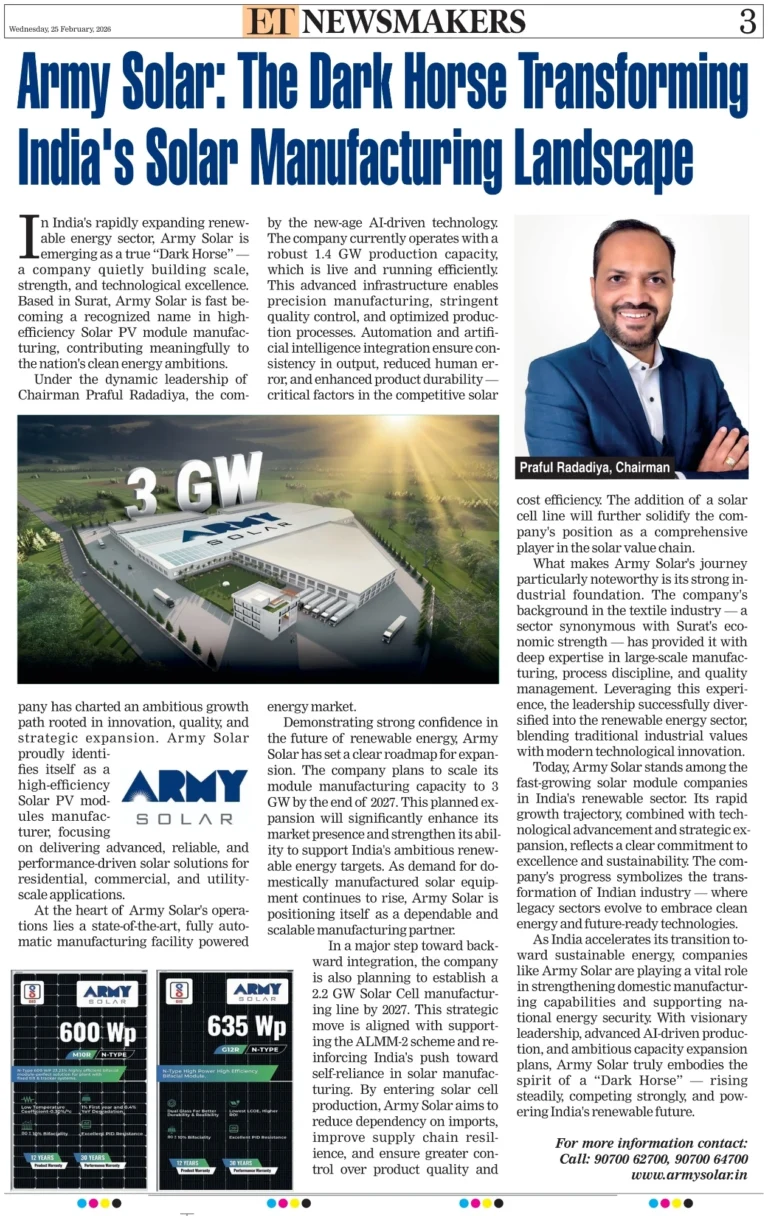
Advanced Manufacturing Powered by Technology
One of the defining features of Army Solar is its state-of-the-art manufacturing facility, which integrates modern automation and artificial intelligence technologies.
Currently, the company operates with a 1.4 GW solar module production capacity, supported by advanced manufacturing systems designed for precision and efficiency.
These automated production systems offer several advantages:
- Improved manufacturing accuracy
- Consistent product quality
- Reduced human error
- Higher production efficiency
- Enhanced module durability
AI-driven monitoring and automated quality control allow the company to maintain strict manufacturing standards while optimizing the entire production workflow.
This approach ensures that the solar modules produced meet global efficiency and reliability benchmarks.
Building a Strong Solar Product Portfolio
Army Solar focuses on manufacturing high-performance solar photovoltaic modules suitable for multiple energy applications.
Its product portfolio includes advanced solar modules designed to deliver:
- Higher power output
- Improved efficiency
- Long operational life
- Better performance in varied environmental conditions
Among the modules being developed are high-power models such as 600 Wp and 635 Wp solar panels, built using modern technologies like N-Type cells and high-efficiency bifacial designs.
These modules are designed to maximize energy generation while minimizing energy loss, making them ideal for both large-scale solar farms and commercial installations.
Vision for Expansion: Scaling to 3 GW
Army Solar is not limiting itself to its current capacity. The company has already laid out an ambitious expansion roadmap.
By 2027, the company plans to expand its solar module manufacturing capacity to 3 GW, which will significantly strengthen its position in India’s solar manufacturing sector.
This expansion is expected to:
- Increase production capabilities
- Improve supply chain efficiency
- Strengthen the company’s market presence
- Support India’s renewable energy goals
The growing demand for locally manufactured solar equipment has created a strong opportunity for domestic manufacturers, and Army Solar is positioning itself to capture this opportunity.
Moving Toward Backward Integration
In addition to expanding module production, Army Solar is also planning to establish a 2.2 GW solar cell manufacturing line by the financial year 2026-27.
This step toward backward integration will allow the company to manufacture solar cells domestically instead of relying on imports.
Backward integration offers several strategic advantages:
- Reduced dependency on foreign suppliers
- Improved cost efficiency
- Better supply chain control
- Higher product quality assurance
This initiative also aligns with India’s ALMM (Approved List of Models and Manufacturers) framework and the government’s vision to promote self-reliance in solar manufacturing.
By producing solar cells in-house, Army Solar aims to become a more integrated and competitive player in the solar value chain.
Leadership Driving Strategic Growth
The company’s progress is guided by the leadership of Chairman Praful Radadiya, whose vision focuses on innovation, quality, and strategic growth.
Under his leadership, Army Solar has developed a strong industrial foundation while embracing modern technology and renewable energy innovation.
The leadership team combines experience from traditional manufacturing sectors with forward-looking strategies designed for the clean energy economy.
This blend of industrial discipline and technological innovation has helped the company accelerate its growth trajectory.
Surat: A Strong Industrial Foundation
Army Solar’s roots in Surat provide a strong advantage. The city is widely known for its thriving textile and manufacturing industries, which have built a culture of operational excellence and large-scale production expertise.
This industrial ecosystem offers:
- Skilled workforce availability
- Established manufacturing infrastructure
- Strong logistics connectivity
- Entrepreneurial business environment
Leveraging this ecosystem, Army Solar has been able to build a scalable and efficient manufacturing setup that supports rapid growth.
Supporting India’s Renewable Energy Mission
India’s transition toward sustainable energy requires strong domestic manufacturing capabilities. Import dependency can slow down project execution and increase costs for developers.
Companies like Army Solar are helping address this challenge by strengthening local production capacity.
By manufacturing high-efficiency solar modules within India, the company contributes to:
- Domestic energy security
- Lower solar project costs
- Reduced reliance on imports
- Growth of India’s renewable energy ecosystem
As demand for solar installations continues to rise, domestic manufacturers will play a crucial role in meeting future energy needs.
A Promising Future for Army Solar
Army Solar’s journey reflects the transformation taking place in India’s manufacturing sector. Traditional industrial capabilities are increasingly being combined with modern technologies such as automation, AI, and advanced material science.
With its focus on:
- Advanced manufacturing
- High-efficiency solar technology
- Strategic capacity expansion
- Backward integration into solar cells
The company is steadily building a strong position within India’s solar industry.
What once appeared as an emerging player is now gaining recognition as a fast-growing solar manufacturing company with long-term potential.