
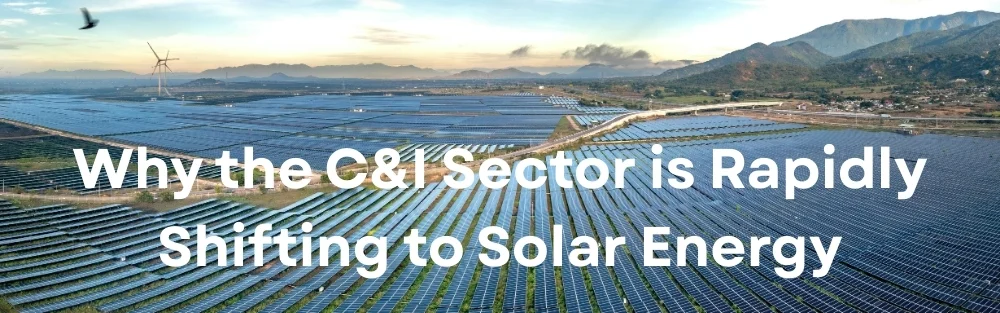
Rising Electricity Costs & the Push Toward 100% Renewable Energy
Walk into any factory, warehouse, or large commercial facility today, and you’ll hear the same concern repeated again and again — electricity bills are getting out of control.
For years, power costs were just another operational expense. But now, they’ve become one of the biggest pressures on profitability. At the same time, a new shift is happening — companies are no longer just trying to reduce costs, they’re actively moving toward 100% renewable energy.
This combination of rising expenses and sustainability goals is exactly why the Commercial & Industrial (C&I) sector is rapidly adopting solar energy.
Let’s break down what’s really driving this transformation.
The Real Problem: Rising Electricity Costs Are Hurting Businesses
Electricity tariffs for commercial and industrial users have been steadily increasing. Unlike residential consumers, C&I users often pay higher rates, along with demand charges, peak-hour penalties, and other hidden costs.
For industries running heavy machinery or 24/7 operations, this creates a serious challenge:
- Monthly bills become unpredictable
- Peak-hour costs spike expenses
- Profit margins shrink
In sectors like manufacturing, textiles, cold storage, and logistics, electricity isn’t optional — it’s the backbone of operations. When energy costs rise, everything from production to pricing is affected.
Businesses have tried different ways to manage this:
- Switching suppliers
- Optimizing operations
- Investing in energy-efficient equipment
But these solutions only offer partial relief. The core issue — dependence on grid power — remains.
That’s where solar changes the equation.
Solar Energy: From Alternative to Essential
A few years ago, solar energy was seen as an “extra” or an environmentally friendly option. Today, it has become a financial decision.
By installing a solar system, businesses can:
- Generate their own electricity
- Reduce dependency on the grid
- Lock in energy costs for 20–25 years
This last point is critical. While grid electricity prices continue to rise, solar offers cost stability — something every business values.
For many companies, the shift is simple math:
Pay rising electricity bills forever, or invest once and reduce costs for decades.
The Second Big Shift: Companies Moving Toward 100% Renewable Energy
Cost savings alone aren’t the only driver anymore.
Across industries, companies are now committing to sustainability goals:
- Reducing carbon footprint
- Meeting ESG (Environmental, Social, Governance) targets
- Aligning with global supply chain requirements
Large corporations, exporters, and even mid-sized businesses are under increasing pressure from:
- International clients
- Government policies
- Investors and stakeholders
Many global brands now prefer or even require their partners to use renewable energy. This means Indian manufacturers and suppliers must adapt to stay competitive.
Solar energy becomes the easiest and most practical way to:
- Show compliance
- Build a green brand image
- Stay future-ready
Why Solar Makes Perfect Sense for C&I Sector
The C&I segment is actually the best fit for solar adoption.
1. Large Rooftop Space
Factories and warehouses usually have huge rooftops — ideal for installing solar panels without extra land cost.
2. Daytime Energy Consumption
Most industrial operations run during the day, which perfectly matches solar generation.
3. Faster ROI
Compared to residential users, businesses recover their investment much faster due to higher electricity tariffs.
4. Scalability
Solar systems can be expanded as the business grows.
Beyond Savings: Strategic Advantages of Solar
Businesses that adopt solar early are already seeing benefits beyond just lower bills:
✔ Better Financial Planning
Stable energy costs help in long-term budgeting.
✔ Increased Property Value
Solar-powered facilities are more attractive to investors and buyers.
✔ Brand Positioning
Being seen as a sustainable company adds real market value.
✔ Energy Independence
Less reliance on grid failures and price fluctuations.
The Future is Hybrid: Solar + Smart Energy Systems
The next phase of solar adoption is not just about panels. It’s about complete energy solutions:
- Solar + battery storage
- Smart monitoring systems
- Energy optimization technologies
This allows businesses to:
- Store excess energy
- Use power during peak hours
- Maximize efficiency
In simple terms, companies are moving from using electricity to managing energy smartly.
Where Army Solar Fits In
As the market evolves, choosing the right solar partner becomes just as important as choosing solar itself.
This is where Army Solar stands strong.
✔ Manufacturing Strength
Army Solar is not just an installer — it is a solar panel manufacturer, ensuring better control over quality, performance, and reliability.
✔ Built for Industrial Needs
The solutions are designed keeping C&I requirements in mind — high efficiency, durability, and long-term performance.
✔ Future-Ready Technology
With the industry moving toward advanced technologies like high-efficiency modules and smart energy systems, Army Solar focuses on delivering future-ready solar solutions, not outdated setups.
✔ Reliability & Trust
For businesses, downtime is not an option. Army Solar systems are built to deliver consistent performance over years.
✔ Scalable Solutions
Whether it’s a small factory or a large industrial unit, systems can be designed and expanded as per requirement.